In recent years, the financial industry has witnessed a transformative shift as artificial intelligence (AI) technologies gain prominence in various sectors. One area where AI is making a significant impact is in the realm of private equity and principal investment. As firms seek innovative ways to enhance decision-making, streamline operations, and uncover new opportunities, AI has emerged as a valuable tool with a diverse range of applications.
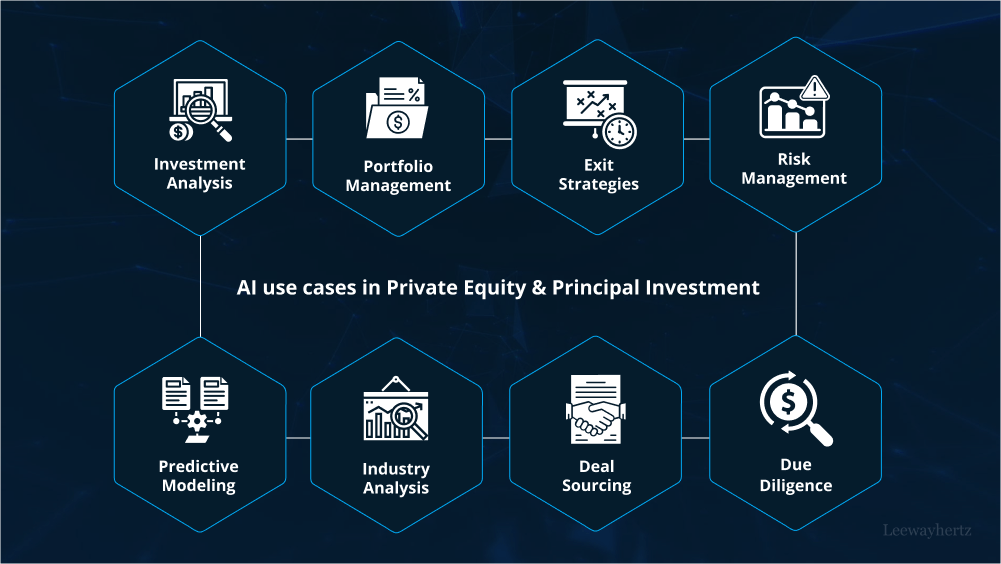
1. Data-driven Due Diligence:
One of the core activities in private equity and principal investment is due diligence, the meticulous process of assessing investment opportunities. AI has revolutionized this aspect by enabling faster and more accurate analysis of massive datasets. Machine learning algorithms can sift through vast amounts of financial, operational, and market data to identify trends and potential risks, providing valuable insights that inform investment decisions. AI-driven due diligence also helps in identifying hidden patterns that might go unnoticed by human analysts, enhancing the quality of investment choices.
2. Predictive Analytics for Investment Performance:
AI excels in predictive analytics, offering a new dimension to investment strategies. By analyzing historical data, market trends, and macroeconomic factors, AI models can forecast potential investment performance. These predictive models aid in assessing risk, estimating returns, and optimizing portfolio allocation. Private equity firms leverage AI algorithms to gauge the future profitability of investments and adjust their strategies accordingly, leading to more informed and prudent decisions.
3. Automated Deal Sourcing:
Finding viable investment opportunities is a fundamental challenge in private equity. AI-powered tools are addressing this issue by automating the deal sourcing process. Natural language processing (NLP) algorithms scour vast amounts of unstructured data, including news articles, press releases, and industry reports, to identify potential targets that align with the investment criteria. This automation not only accelerates the sourcing process but also helps firms stay ahead of market trends.
4. Risk Management and Fraud Detection:
Managing risks is paramount in the world of finance. AI aids in risk assessment by identifying potential vulnerabilities in investment portfolios. Machine learning algorithms can analyze complex correlations between different assets and market variables, offering a holistic view of risk exposure. Additionally, AI-powered fraud detection systems use anomaly detection algorithms to flag unusual patterns in financial transactions, safeguarding investments from potential threats.
5. Portfolio Optimization:
Optimizing investment portfolios involves intricate analysis of various factors, including asset performance, correlations, and market conditions. AI algorithms excel in this area by leveraging advanced optimization techniques. By considering multiple variables simultaneously, AI models can design portfolios that maximize returns while minimizing risks, offering a quantitative and data-driven approach to portfolio management.
6. Sentiment Analysis:
AI’s ability to analyze sentiment from news articles, social media, and other sources provides valuable insights into market trends. Sentiment analysis helps investment professionals gauge market sentiment, track public perception of companies, and anticipate market shifts. This information can be crucial in making timely and informed investment decisions.
7. Enhanced Post-Investment Management:
AI doesn’t just play a role in the pre-investment phase; it also offers benefits during the post-investment phase. AI-powered analytics can monitor the performance of portfolio companies in real-time, tracking key metrics and providing early warnings about potential issues. This proactive approach to post-investment management can lead to more effective decision-making and timely interventions to protect investments.
In conclusion, the integration of AI in private equity and principal investment has transformed the way financial professionals approach decision-making, risk assessment, and portfolio management. From data-driven due diligence and predictive analytics to automated deal sourcing and risk management, AI technologies offer a wide range of applications that enhance efficiency and improve outcomes. As the capabilities of AI continue to evolve, its role in private equity is likely to expand further, enabling investment firms to stay competitive in an ever-changing financial landscape.

 Jasper's Video Blog
Leave a comment