Artificial Intelligence (AI) has revolutionized various industries, and the healthcare sector is no exception. Generative AI, a subset of AI, is making significant strides in transforming the landscape of healthcare. Generative AI uses machine learning algorithms to create new data based on patterns found in existing datasets. Its ability to generate realistic and valuable content has opened up numerous use cases in the medical field. In this article, we explore ten compelling use cases of generative AI in healthcare.
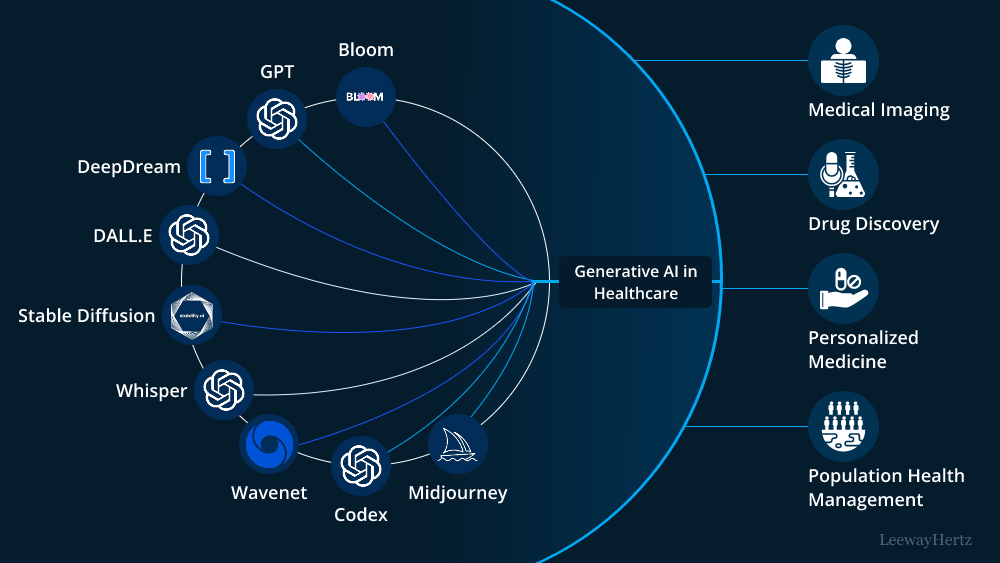
- Medical Image Generation
Generative AI can create synthetic medical images that closely resemble real patient data. This capability is particularly useful in training and testing medical imaging algorithms, such as MRI and CT scan analysis. It allows researchers to generate large datasets of diverse images, helping in the development and validation of new diagnostic tools and image enhancement techniques.
- Drug Discovery
Pharmaceutical companies are leveraging generative AI to expedite drug discovery processes. By analyzing vast amounts of chemical and biological data, AI can predict potential drug candidates, design new molecules, and optimize existing ones. This accelerates the identification of promising compounds, reducing costs and time associated with traditional drug development.
- Personalized Treatment Plans
Generative AI models can analyze patient data, including medical history, genetics, and lifestyle factors, to create personalized treatment plans. By tailoring treatments to individual patients, healthcare providers can improve treatment efficacy and patient outcomes, enhancing the overall quality of care.
- Natural Language Generation for Medical Reports
Generating medical reports can be time-consuming for healthcare professionals. Generative AI can be employed to automatically generate detailed and accurate medical reports based on patient data, examination results, and diagnostic tests. This not only saves time but also reduces the risk of errors in documentation.
- Virtual Patient Simulations
Generative AI enables the creation of virtual patient simulations, replicating various medical conditions and scenarios. Medical students and professionals can interact with these virtual patients to practice diagnostic skills, surgical procedures, and decision-making in a risk-free environment, enhancing their expertise and competence.
- Disease Progression Modeling
Understanding how diseases progress is essential for developing effective treatment strategies. Generative AI can analyze longitudinal patient data and model disease progression patterns. This aids in predicting disease trajectories, identifying critical stages, and devising timely interventions to halt or slow disease progression.
- Synthetic Data Generation for Privacy Protection
Preserving patient privacy while allowing researchers access to valuable data is a challenging task. Generative AI can generate synthetic data that maintains the statistical characteristics of real patient data while protecting individual identities. This synthetic data can be shared with researchers without compromising patient privacy.
- Predictive Analytics in Remote Monitoring
Generative AI algorithms can be applied to remote patient monitoring data to predict health deterioration and potential complications. By analyzing vital signs and patient-reported data, healthcare providers can intervene proactively, reducing hospital readmissions and improving patient care.
- Mental Health Support
Generative AI-powered chatbots and virtual assistants can offer mental health support by engaging in conversations with patients. These AI companions can provide empathy, offer coping strategies, and recommend appropriate resources, helping to alleviate the burden on mental health professionals and increasing accessibility to support.
- Drug Dosage Optimization
Determining the optimal drug dosage for individual patients is a critical aspect of medical treatment. Generative AI can analyze patient data, pharmacological profiles, and treatment outcomes to recommend personalized drug dosages, reducing the risk of adverse effects and improving medication efficacy.
Conclusion
Generative AI holds immense potential in revolutionizing healthcare across various domains. From aiding in medical image generation and drug discovery to supporting mental health and enhancing personalized treatment plans, its applications are wide-ranging and impactful. Embracing generative AI technologies in healthcare has the potential to transform patient outcomes, optimize treatment approaches, and drive medical advancements into the future. As these AI technologies continue to evolve, it is crucial to prioritize ethical considerations, data security, and regulatory compliance to ensure that they benefit both patients and healthcare providers alike.
To Learn More:- https://www.leewayhertz.com/generative-ai-in-healthcare/

 Jasper's Video Blog
Leave a comment