Artificial Intelligence (AI) has transformed various industries, and private equity and principal investment are no exceptions. The implementation of AI technologies has revolutionized the way these sectors operate, enabling enhanced decision-making, improved due diligence, and increased operational efficiency. Let’s explore some of the key use cases and applications of AI in private equity and principal investment.
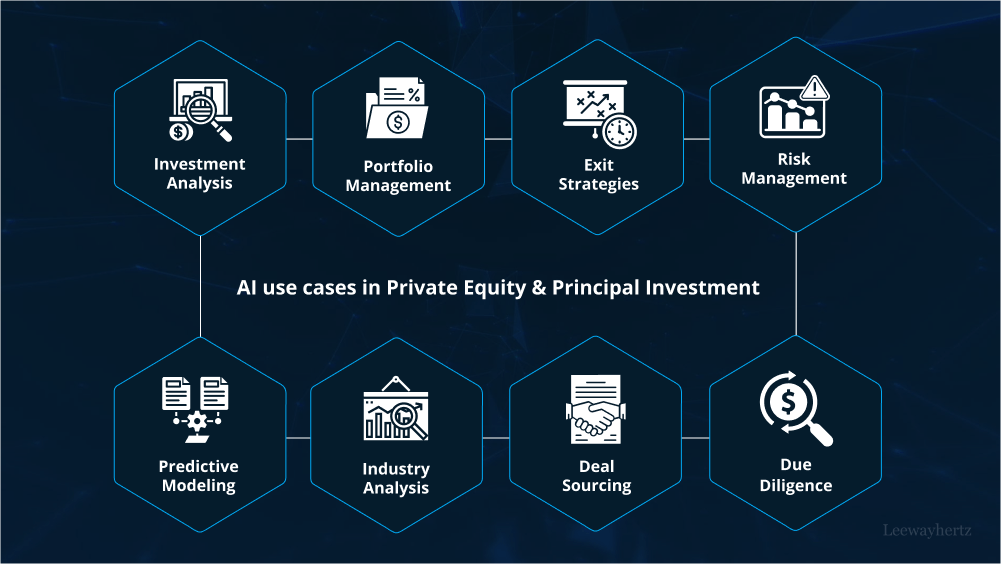
1. Data Analysis and Decision Support:
AI-powered algorithms can analyze vast amounts of structured and unstructured data, enabling investors to identify potential investment opportunities more efficiently.
Natural Language Processing (NLP) algorithms can sift through documents, news articles, and industry reports to extract relevant insights, aiding investment decision-making.
AI-driven predictive analytics models can forecast market trends, evaluate investment risks, and provide real-time portfolio monitoring.
2. Risk Assessment and Mitigation:
AI algorithms can assess investment risks by analyzing historical data, market trends, and macroeconomic indicators. This allows investors to make informed decisions and develop risk mitigation strategies.
Machine Learning (ML) models can detect patterns and anomalies in financial data, helping to identify potential fraud or non-compliance issues.
AI-powered algorithms can conduct stress testing and scenario analysis, evaluating the impact of various market conditions on investment portfolios.
3. Deal Sourcing and Due Diligence:
AI can streamline deal sourcing by analyzing vast amounts of data from multiple sources, such as company databases, news feeds, and social media. This helps identify potential investment targets and provides insights into market dynamics.
Natural Language Processing algorithms can automate due diligence processes by analyzing legal documents, contracts, and regulatory filings, saving time and improving accuracy.
AI-powered tools can assist in financial modeling, valuation, and scenario analysis, enhancing the speed and accuracy of investment decision-making.
4. Operational Efficiency and Automation:
AI technologies, such as Robotic Process Automation (RPA), can automate repetitive and manual tasks, such as data entry, report generation, and reconciliation. This reduces operational costs and frees up valuable resources for more strategic activities.
AI-driven chatbots and virtual assistants can enhance customer service, answering queries, providing portfolio updates, and facilitating communication with investors.
Predictive maintenance algorithms can optimize asset management by identifying potential maintenance needs and predicting equipment failures, reducing downtime and improving operational efficiency.
5. Portfolio Management and Optimization:
AI-powered portfolio management platforms can analyze historical performance, market trends, and investor preferences to optimize asset allocation and portfolio diversification.
ML algorithms can continuously monitor and analyze real-time data, making data-driven investment decisions and adjusting portfolios accordingly.
AI-driven algorithms can provide personalized investment recommendations to individual investors, taking into account their risk appetite, financial goals, and market conditions.
6. Exit Strategy and Value Creation:
AI can assist in evaluating exit strategies by analyzing market conditions, competitive landscape, and financial performance, helping investors maximize their returns.
ML models can identify potential buyers, investors, or partners for portfolio companies, facilitating strategic collaborations and M&A activities.
AI-driven algorithms can optimize pricing strategies, enabling investors to determine the most favorable valuation for their investments.
In conclusion, AI has brought significant advancements to private equity and principal investment. From data analysis and decision support to risk assessment and portfolio optimization, AI technologies have enhanced operational efficiency, improved due diligence, and enabled more informed investment decision-making. As AI continues to evolve, it is expected to play an increasingly vital role in these sectors, driving innovation, and delivering greater value to investors and stakeholders.
To Learn More:- https://www.leewayhertz.com/ai-use-cases-in-private-equity-and-principal-investment/

 Jasper's Video Blog
Leave a comment